Whenever you consider transporting bulky, large, or oddly shaped goods, a single type of trailer comes to mind almost immediately: the flatbed trailer.
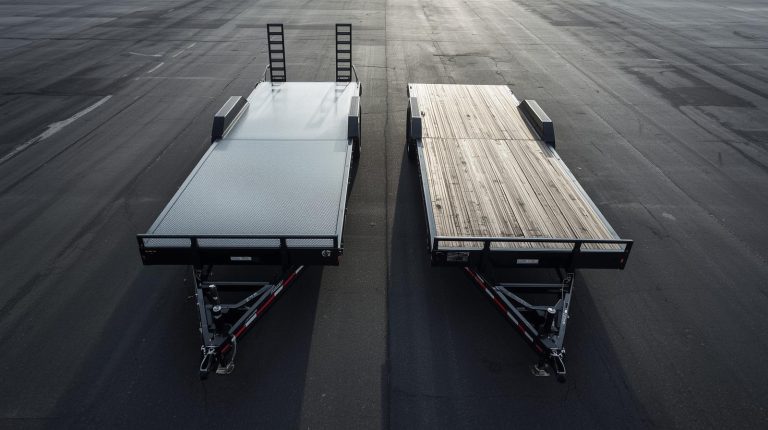
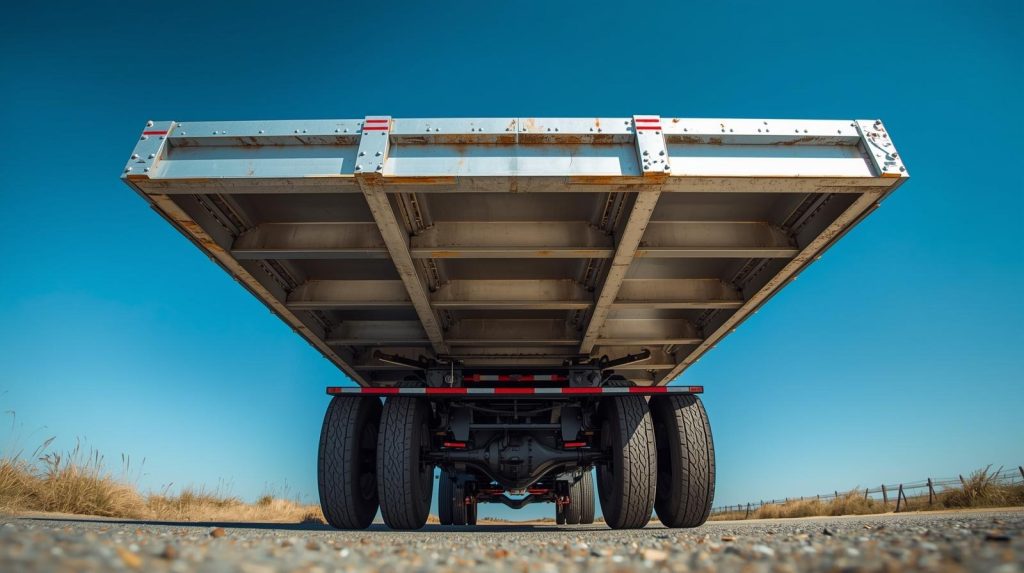
A flatbed trailer is an open-deck trailer where the sides and the roof are absent; it is used to carry oversized, hefty, or irregularly shaped cargo.
Unlike enclosed trailers, flatbeds offer free loading of the sides, top, or rear, which is integral to industries that demand streamlined freight management. The loading and offloading of goods are a lot easier due to the flat body.
Because of the flatbed truck’s open body, the goods in it cannot be exposed to rain. The trailer is one of the most utilized due to its versatility. On average, the trailer length is between 48 and 53 feet.
From hauling construction equipment and machinery to lumber or large vehicles, flatbed trailers offer a reliable option that is designed to withstand, bend, and endure.
Flatbed Trailer Specifications And Dimensions
Knowing trailer specifications makes it easier to match the appropriate equipment for each task. For cost, safety, and regulatory compliance, every inch and pound counts.
Specification
- Standard Measurement
- 48–53 feet in length
- The standard legal width is 8.5 feet.
- Without permission, the height limit for freight is 8.5 feet.
- Approximately 48,000 pounds is the maximum freight weight.
Selecting the ideal flatbed is dependent upon:
- The equipment’s weight class
- Requirements for height clearance
- Method of loading (crane, ramp, or forklift)
- Needs for fastening
Types Of Flatbed Trailers
These are the most popular varieties of flatbed trailers, together with their normal features and benefits.
Standard Flat Top Trailers
For general heavy transportation, these are the best options. The Australian-made 8×6 Flat Top Single Axle Trailer is perfect for regular utility transportation.
Tandem Axle Flat Tops
Tandem axle trailers, such as the 10×6 Flat Top and 12×7 Flat Top, are ideal for heavier loads and more demanding use because they provide greater stability and weight distribution.
ITS Suspension Models
The Integrated Trailer Suspension (ITS) improves towing stability and load support. These are a well-liked update for business users. Examples consist of:
14×7 Flat Top (ITS Suspension)
16×8 Flat Top (ITS Suspension)
Hydraulic Flat Top Tippers
Do you need to unload right away? Heavy material disposal is made simple and effective with hydraulic tipping flatbeds:
12×7 Hydraulic Flat Top Tipper
14×7 Hydraulic Flat Top Tipper
Heavy-Duty Tri-Axle Flat Tops
The 20×8 Flat Top 3500KG Tri-axle Trailer provides exceptional stability and weight-bearing capabilities for heavy transporting tasks.
Curtain Side Trailer
A curtain side trailer is a cross between an enclosed and flatbed trailer. It has a rolling tarp system that may be completely enclosed or retracted.
Extendable Flatbed Trailer
Extensible flatbed trailer, sometimes referred to as a stretch flatbed, is perfect for the accommodation of Extra-long goods. The trailer lengthens to accommodate materials that are abnormally long.
Lowboy Trailer
Because of its incredibly low deck height, a lowboy trailer is perfect for moving large, heavy cargo that would be too tall for other trailers. The deck height of these trailers is lowered twice: once before the rear axles and once immediately after the gooseneck.
Removable Gooseneck (RGN) Trailer
Similar to a lowboy, an RGN trailer features a detachable front portion that enables the trailer to descend to the ground and form an integrated loading ramp. It is therefore among the finest choices for big machinery that can load itself.
Key Features Of Flatbed Trailers
Open Deck Design: Since there are no walls or roof, loading from any direction; side, rear, or crane lift from above; becomes effortless.
Weight Capacity: With ATM load ratings of up to 4,500 kg, flatbed trailers are appropriate for a variety of heavy-duty applications.
Durable Construction: All Modern Trailers are constructed to endure rough use over time using high-strength materials and Australian conditions.
Advantages Of Flatbed Trailers
- The open design makes it quicker, less expensive, and safer to load from either side.
- Manages equipment and shapes that are not typical.
- Facilitates quicker loading and unloading using forklifts or cranes.
- Ideal for freight related to construction, industry, and agriculture.
Flatbed Maintenance & Care
- Routine Inspections: It is essential to have a regular inspection program. High-risk components should be the focus of monthly inspections to find early indications of wear or damage. This includes inspecting the suspension systems, securement points, and undercarriage of the trailer. Remember to routinely check the trailer for corrosion and rust.
- Longevity Tips: Clean the underside of the trailer often, especially after driving in mud, rain, or salty conditions. This helps stop rust and harmful buildup. Adding protective coatings to weak or exposed areas also helps guard against weather damage and keeps the trailer in good shape for longer.
Final Thoughts
There is more to flatbed carrying than just trucks and trailers. Planning, accuracy, dependability, and communication are key. At Rock And Roll Dispatch, we believe that every load should be handled carefully and communicated clearly from beginning to end. Our skilled dispatchers in the USA meticulously arrange each transfer to ensure the safety of the trucker’s cargo and the timely completion of your project.