
The variety of freight transported by 18-wheelers all around the country is enormous: from cars, robotics, and electronic devices to household products and foodstuffs. Similarly, demand for trucking services keeps rising, driven up by a constant increase in cargo shipments. But for the truckers, there are plenty of choices when it comes to the trailer you use. Not only does this affect the hauling capacity and profitability, but it plays a significant role in the security and safety of the cargo.
For new drivers choosing a first driving job, the choice between a dry van truck career and a flatbed truck career can shape your lifestyle and earnings path. The dry van trailer is typically 53 feet long, and fully enclosed with four walls and a roof. A flatbed, on the other hand, is a type of trailer that has an open-top platform with no walls or roof.
While these are only two of the several types of trucking careers available, flatbed and dry van are some of the most widespread modes of transport, and experience with one or the other is usually required when looking to get into more specialized driving, like tanker or auto haulers.
What Is Dry Van Trailer
In the freight transportation sector, dry van trailers are the most commonly used kind. Usually measuring 53 feet in length, these trailers are completely contained by four walls and a roof. Its design protects the cargo from inclement weather and variations in humidity, which is what distinguishes it from other types of trailers. The dry van can be equipped with additional cargo securement devices to offer further defense against theft, tampering, falling, and shifting while in transit.
Specs
An enclosed trailer used to transport cargo, usually behind a semi-truck, is called a dry van trailer. A dry van’s cargo unit typically measures 53 feet in length by 8.5 feet (102 inches) in width. The internal height measures around 110 inches, while the exterior height is about 13′ 6″.
Types
Sheet and Post Dry Vans
Plate Dry Vans
Custom Spec Dry Vans
Pros
Dry van trailers are used to transport the majority of commercial goods from the warehouse to your neighborhood retailer.
Dry vans are completely enclosed on all sides, protecting the cargo from heat, humidity changes, sleet, rain, and snow.
This kind of trailer is regarded as one of the most reasonably priced truckload trailers.
Cons
Dry vans don’t have temperature control as reefer traucks do.
It is only possible to load and unload dry vans from the back.
Because dry van floors are primarily made of wood, they may be susceptible to moisture.
What Is A Flatbed Trailer
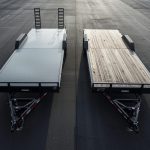
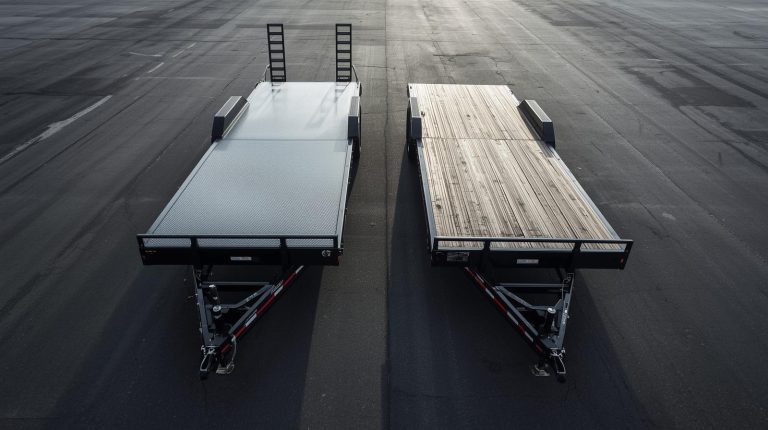
Flatbed trailers are frequently utilized because of their adaptability and capacity to transport large loads. These are the ideal choice for moving cars, construction equipment, and other bulky items because they have no enclosure and can be loaded from the sides or from above.
Although a flatbed’s structure is typically composed of steel, it can also be constructed of wood or aluminum. Flatbeds are available in a variety of widths and lengths, depending on the amount and kind of load that needs to be moved. The frames additionally feature tie-down points in order to aid secure the cargo during transit. The majority of flatbeds also feature rails along their sides for increased stability and load safety.
Specs
A flatbed trailer is made without walls or a ceiling, in contrast to a dry van. Its lack of a top and sides makes it easier to move huge machinery that wouldn’t fit in a hidden container and enables trucks to load from several angles. Although the width is roughly the same at 102 inches, these trailers are slightly shorter at a typical 48-foot length than dry vans.
Types
Steel Flatbeds
Composite Flatbeds
Aluminum Flatbeds
Pros
A flatbed truck driver makes more money than a dry van truck driver.
A flatbed trailer may accommodate unique loads and even large items.
Flatbed truckers will always have lots of work and opportunities to improve in their careers because the demand for flatbeds is constantly increasing.
Cons
Compared to dry vans, this kind of trailer is more vulnerable to weather.
Flatbed trucks can be challenging to maneuver on some highways particularly in places with narrow streets and bends, because of their size.
Because the cargo is exposed on all sides, flatbeds necessitate greater freight security.
Dry Van Trailer Vs Flatbed Trailer- Quick Comparison
| Feature | Dry Van Trailer | Flatbed Trailer |
| Cargo Type | Packaged goods, boxed items, consumer products | Oversized, heavy, irregularly shaped freight |
| Weather Protection | Fully enclosed; protects cargo from rain, wind, and sun | Exposed to weather; needs tarps and straps to secure cargo |
| Security | Lockable trailer for theft prevention | Cargo is exposed; requires secure tie-downs |
| Loading & Unloading | Requires a loading dock | Can be loaded from sides, top, or rear |
| Best Industries | Retail, food distribution, general freight | Construction, agriculture, heavy equipment |
| Shipping Costs | Typically lower for standard freight | Higher due to specialized loads and equipment |
| Versatility | Less flexible for odd-shaped cargo | Highly versatile; can carry large or unusual loads |
| Setup Time | Quick to hook and go | Requires more preparation for securing cargo |
| Safety Considerations | Lower risk of cargo damage in transit | Risk of damage if not properly secured |
Flatbed Or Dry Vans For New Drivers
If you’re just starting as a truck driver or a new authority, here’s the real deal: dry van is like driving a big moving box; you back up to a dock, someone else loads it, you close the doors, and hit the road. It’s straightforward, keeps you out of the weather, and you’re home free once those doors are locked.
Flatbed, on the other hand, means you’re climbing on that trailer in the rain or shine, throwing tarps, and making sure everything’s strapped down tight; it’s more physical work and takes longer at each stop.
But here’s the kicker: flatbed drivers usually make 10-15% more money because of that extra effort. So ask yourself: do you want an easier learning curve and more predictable days, or are you willing to get your hands dirty (literally) for a fatter paycheck and skills that’ll make you more valuable down the road?