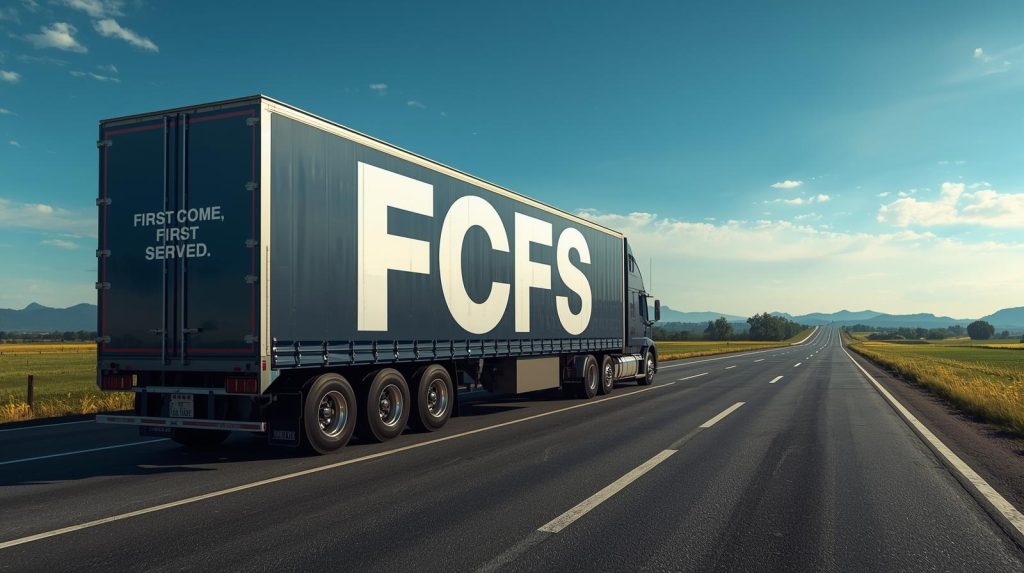
The trucking industry operates on various scheduling methods, and FCFS stands as one of the most straightforward approaches to warehouse operations. This scheduling model follows a simple principle: whichever truck arrives first at a facility gets served before others, regardless of load priority or carrier status. Shippers and receivers implement this order of arrival system to eliminate the complexity of managing appointment slots at their loading dock.
Drivers show up within scheduled time-frames set by the facility, join the waiting line, and expect to be loaded or offloaded based purely on when they arrive. The model sounds fair in theory; everyone gets equal treatment without favoritism, but reality paints a different picture.
FCFS Meaning in Trucking- How FCFS Scheduling Works at Loading Facilities
Freight movements under FCFS scheduling require drivers to arrive within the shipper or receiver facility’s hours of operation, which typically vary from company to company. Some facilities might accept trucks from 8 AM to 1 PM, while others maintain different windows. The process begins when a driver pulls into the facility, checks in, and receives a position in the queue.
Generally, the waiting time in a First Come, First Served (FCFS) system depends on factors such as the frequency of truck arrivals, the availability of docks, and the time required for loading or unloading. In well-managed FCFS warehouses, the average wait time is about 30 minutes to 2 hours, depending on how much cargo there is.
However, a facility claiming to unload 1 truck at a time with 1-hour duration per truck unload means the fifth truck arriving at 8 AM won’t start unloading until noon, resulting in five hours of waiting. This creates three hours of detention time, and using the national average detention rate of $65 per hour, detention fees accumulate rapidly, potentially reaching $390 for just 6 hours of total detention across five trucks on a single day.
When talking about how to calculate FCFS, it can be analyzed mathematically
Average Waiting Time = (Total Service Time – Arrival Time of First Truck) / Number of Trucks
The Impact on Truck Drivers and Hours of Service
Truck drivers face unique challenges under the first come first serve approach, particularly regarding Federal Motor Carrier Safety Administration HOS regulations. These rules strictly limit drivers to 14 hours of being actively on duty per day to ensure road safety. When drivers arrive at an FCFS facility expecting quick loading or unloading, they prioritize efficiency to optimize their HOS clock.
The best-case scenario involves arriving as the early bird and getting served immediately, allowing the driver to maintain their schedule and reach subsequent appointments without delays. However, drivers frequently find themselves stuck behind countless trucks in the line, watching precious driving hours evaporate while waiting for their turn at the loading dock.
The congestion problem intensifies during certain periods, especially on Monday morning when drivers who couldn’t deliver during the weekend all converge simultaneously. Operating smoothly, FCFS facilities can aid drivers in their effort to maintain control over their daily schedule, but inefficient operations turn the system into a time-consuming ordeal.
Why Some Facilities Choose FCFS Over Appointment Scheduling
Shippers and receivers adopt FCFS for various reasons, primarily centered on simplicity and resource requirements. The model eliminates the need for staff to schedule and manage loading dock appointments on top of their regular duties, which appeals to facilities lacking sophisticated scheduling system infrastructure.
Companies with high-volume freight movements and adequate yard space find FCFS particularly feasible. Having a large amount of loading yard area becomes key to this scheduling model since multiple trucks need room to maneuver amongst each other while waiting. Facilities that invest the resources to employ highly-skilled full-time workers like experienced crane operators, forklift drivers, and yard jockeys make the system work more efficiently.
For carriers, understanding which facilities operate under FCFS versus appointment-based systems is critical for route planning and rate negotiation. Professional dispatchers maintain detailed facility profiles and can factor in typical wait times when booking loads, ensuring that detention time is either minimized or properly compensated through strategic rate negotiations before accepting the load
The Hidden Costs and Disadvantages of FCFS
While FCFS appears simple to implement, the disadvantages and downsides quickly become apparent at inefficient facilities. The fundamental problem sits right there in the name: the first to arrive gets served and loaded, meaning any trucks, whether it is a box truck, reefer truck, dry van, or a flatbed truck, arriving later must wait their turn regardless of how urgent or critical their loads might be.
Carriers often get burned by congestion at FCFS locations in the past, making them less eager to take freight to these types of facilities and less likely to offer a competitive rate. The flexibility that initially seems attractive quickly turns into a golden cage that traps drivers in line for hours, potentially causing costly delays.
These detention fees represent the immediately quantifiable component, but they do not include the stress and impact on warehouse staff who start their work on Monday morning already behind and playing catch-up. The regular occurrence of this pattern creates a notable impact on morale and possibly attendance. In a warehouse environment, this can translate to unsafe procedures, damaged freight, and disorganized loading docks that require additional labor to correct.
Comparing FCFS to Appointment-Based Scheduling
A facility with all the same criteria but with appointment scheduling operates dramatically differently. Instead of all trucks arriving at 8 AM like the FCFS model, each truck receives a scheduled appointment time. The appointment times are spaced one hour apart to allow for completion of the previous truck and minimize the amount of wait time.
If all trucks arrived at their scheduled appointment time, this warehouse location would incur no detention fees. In this example, that represents a $390 savings for a single day using five only trucks. From the carrier’s perspective, they can better plan their time and subsequent appointments.
In the FCFS warehouse, carriers waited a total of fifteen hours as opposed to the scheduled warehouse, where they waited five hours. Opendock has found that when trucks have a scheduled appointment time, they’re much more likely to arrive near that time. While scheduled appointment times are not perfect, giving all parties a specific time target will significantly improve planning and operations.
How Shippers Can Leverage FCFS Effectively
In the right circumstances with the right resources in place at loading and unloading facilities, an FCFS dock scheduling model can make a lot of sense for shippers and carriers alike. To decide if FCFS is right for a particular operation, facility managers must make sure to take stock of their individual needs and whether they have the resources, processes, and organizational bandwidth to offer this option for their shipments.
Pivoting the process away from appointment-based scheduling to FCFS could make an impact on the bottom line and the success of the supply chain, especially if the transition can be done efficiently. The quicker the facility will be able to load trucks, and the quicker the loading process, the more desirable transporting that freight will become.
Conclusion
The FCFS system in trucking might sound fair and simple, but it’s a double-edged sword. While it cuts down on complex scheduling, it can also cause long waiting times, detention fees, and wasted driving hours if not managed efficiently. The key lies in proper planning, communication, and smart dock management to make the process smoother for everyone involved.
If you are a truck driver or a new authority looking to save time, boost efficiency, and keep those wheels rolling without unnecessary delays, Rock and Roll Dispatch has your back! Our professional dispatching services ensure your loads are planned perfectly, routes are optimized, and your driving hours are maximized. With us, you don’t just move freight, you move smarter.