
Dealing with a growing trucking business? That is great! But what if you have to book a heavy haul load? It can be challenging to ship, so you have to be prepared accordingly. If a load exceeds the permitted sizing or weight, it is classified as an oversized load, over-length load, or over-dimensional load.
Although the restrictions in different states vary, a general federal guideline says that the maximum length should be 75, the width should be 8’6, the height should be 13’6, and the overall weight should not exceed 80000 pounds. Except for this, there are a lot of things to consider if you are carrying oversized loads in trucks.
Below is everything you need to know.
What Are Some Common Types Of Oversized Loads?
The reality of oversized transport spans diverse industries, with manufacturing equipment, structural steel, large pipes, and tanks of all sizes representing common challenges that tip scales into requiring specialized heavy haul service.
Construction machinery like harvesters, bailers, threshers, cranes, and excavators frequently exceed standard dimensions, while prefabricated buildings and building components present unique width and height challenges.
Wind turbine blades, aerial lift equipment, and turbines push length boundaries, often requiring pilot cars and restricted travel times. Military applications add another layer of complexity, and even recreational items like boats can become over-height or wide loads requiring mobile housing considerations.
What qualifies as an oversized load depends on specific measurements, but these items commonly require permits due to their inability to be easily trimmed in size or dismantled without significant resources and time – typically more than 8 hours of work.
`When Standard Transport Rules Don’t Apply
A routine shipment can become complex when freight exceeds standard legal sizing or weight restrictions. What many don’t realize is that an oversized load isn’t just about being large – it’s classified as over-dimensional when your cargo can’t fit within the federal guidelines that govern North America’s transportation network.
Whether you’re moving construction machinery from your manufacturing plant, relocating industrial equipment to a new worksite, or transporting recreational items like boats and yachts, the moment your load exceeds 8.5 feet in width, 13.5 feet in height, or 48,000 lbs in weight, you’ve entered a world where extra care, specialized equipment, and meticulous planning become essential to get from point A to point B safely.
Measurements That Matter- What About An Over-Length Load?
Understanding dimensions isn’t just about knowing your item’s size – it’s about precisely calculating how those measurements interact with state regulations that vary dramatically across the United States and Canadian provinces.
Wide loads exceeding 8’6″ require permits, while anything over 102 inches in width triggers additional restrictions on travel times. Height becomes particularly tricky since East of the Mississippi River, you’re dealing with 13’6″ clearances including trailer height, but West of the Mississippi, that limit jumps to 14′.
Over-length loads extending beyond 5′ from the front or back edge of a standard 48′ trailer immediately classify as overlength, and when you’re dealing with massive items like wind turbine blades that can stretch well beyond the typical 53-foot semi-trailer length, you’re looking at complex routing challenges that require escort vehicles and careful route planning.
The Permit Process Of Overdimensional Load
The permit process represents one of the most challenging aspects of over-dimensional transport, requiring documentation that varies from state to state and becomes exponentially complex for multiple state crossings.
Each Department of Transportation demands specific clearance, and what many shippers don’t realize is that permits are nonrefundable and only valid for a specific period – if your shipment gets delayed, canceled, or extended beyond the permit’s expiration date, you’ll need to reorder them entirely. Single Trip Permits work for one-way moves, Project Permits handle similar loads over the same route during a contract period, while Annual Permits serve businesses with recurring trips.
The key restriction many overlook is that permits cannot be issued for divisible loads – you can’t load two 30,000-pound items on the same trailer and get a 60,000-pound load permit, requiring you to ship separately instead.
Equipment Selection Strategy
Choosing the right equipment demands understanding both weight limits and physical capabilities, because overloading doesn’t just attract serious penalties – it compromises truck handling ability and can cause damage to the entire transport system.
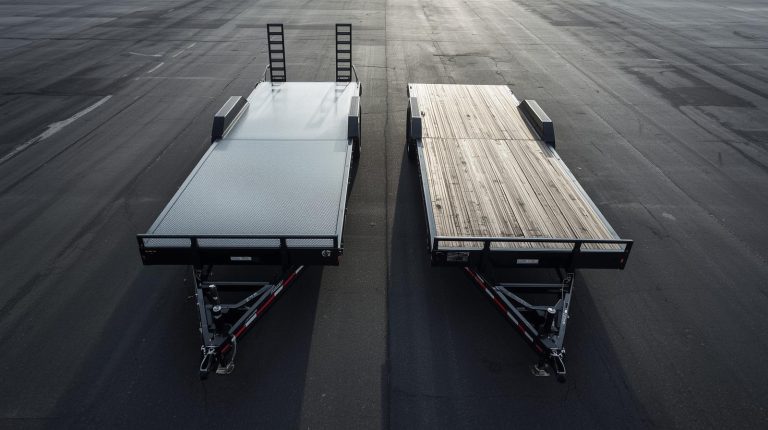
Step deck, drop deck, low boy, and RGN trailers each serve specific purposes, with lower deck height options like double drop trailers sometimes allowing you to avoid oversized permits entirely by keeping loads under that critical 13’6″ imaginary line. The loading and unloading process becomes crucial when your cargo isn’t self-loading like an excavator – you’ll need cranes or forklifts on-site, and ensuring your freight is well-positioned and secured prevents it from falling off and creating chaos on the road.
Flatbed capacity maxes out at 48,000 lbs before triggering overweight classifications, but different trailer types like box trucks, dry vans, or reefer trucks handle various legal weight limitations, making equipment selection a critical factor in successful heavy haul operations.
Safety Through Professional Escort Services
Escort requirements follow a three-tier system that scales with load complexity, starting with Tier 1 loads requiring only permits with no escort needed, progressing to Tier 2 requiring one civilian escort to alert drivers about the oversized load truck and scout ahead for road construction or accidents, and culminating in Tier 3 Super Loads demanding multiple escorts, bucket trucks for moving power lines, and comprehensive route surveys plus bridge surveys.
Loads exceeding 12 feet wide typically require travel escorts, with shippers covering accommodations as part of total freight costs. Law enforcement escorts become mandatory in certain states for super-wide movements, and these civilian escorts serve as your first line of defense against unexpected developments that could disrupt your carefully planned route, making them invaluable for navigating the complex moving parts involved in coordinating oversized transport.
Oversize Freight Shipping Cost
Insurance requirements form a critical foundation for obtaining permits, with liability levels varying significantly based on load classification – routine overweight or oversize loads require $750,000 coverage, while super heavy or oversized loads demand $2,000,000, and non-commercial building movement also requires $2,000,000 in protection.
The cost varies state to state, and your carrier should provide transparent expectations for your entire shipment’s permit expenses. Understanding that permits are nonrefundable becomes crucial for budgeting, especially when dealing with loads that might exceed per-axle limits even when staying under the total weight limit – sometimes modifying the load distribution can make the shipment legal and spare you from needing additional permits.
Tips For Oversized Loads And Operational Excellence In Practice
Success in oversized transport requires 100% accurate and clear measurements from the start, because failing to provide precise information can jeopardize the success of your shipment and create extremely expensive issues to resolve.
Route planning becomes particularly critical for over-height products, requiring thorough pre-checking of routes for height restrictions since the Federal Highway Administration sets bridge and overpass clearances between 14 and 16 feet, but rural areas often have special designs, causing lower bridge clearance. Timing flexibility works in your favor since everyone understands these moves are complicated, but once parts are set in motion – like ordering a crane or forklift – you absolutely must hit your appointment.
If transit delays occur, communicate immediately and clearly with your consignee to delay crane rental rather than rebook these expensive pieces of equipment, and always prioritize communication with your transportation provider to ensure smooth execution of your move.
Conclusion
Oversized loads or over-dimensional loads are known to be a vehicle or cargo that exceeds the standard legal limit set by authorities. As compared to the average load truck, oversize loads need some important steps to consider. Are you dealing with oversized transport? Don’t let it slow your business and; connect with the best dispatching service. Providing the proper assistance from taking load to factoring service, rate negotiation, and document management, we handle everything with utmost care so you can focus on your business. Don’t wait more and contact us today!